

Innovative beauty, part 3
beauty & the skin microbiome

Beauty & Science
As technology evolves and the cost of living rises, the lines between beauty and science continue to blur. Today’s beauty consumer wants proof that the product they’re investing in will actually work, and what better way for brands to prove this than science?
At first, it was enough to have the stamp of approval from a dermatologist (“dermatologist recommended”), then this evolved to claim validations through:
subjective measures: consumer perception studies that capture consumer feedback on the effectiveness of the products.
Ex: “70% of participants who used this product said that they noticed a difference after 2 weeks of use”
objective measures: scientifically validated assessments of how well a product worked such as measuring the skins trans-epidermal water loss (TEWL) to see if the skin retained water better due to implementation of a product or using a cutometer to assess skin elasticity.
Ex: “65% of participants experienced a 30% decrease in TEWL following one week of product use”
Objective measures have become the bread and butter of the beauty industry because the language is seemingly more convincing. This has led to the proliferation of “clinically/scientifically tested” claims and the marketing of “medical grade” skincare.
“Clinically/scientifically tested” usually just means that a brand conducted some form of testing using scientific measurements to evaluate product efficacy.
“Medical grade skincare,” on the other hand, is a loosely defined term. It’s often used to describe products created by medical professionals. Brands like SkinCeuticals, Obagi, Dr. Dennis Gross, and Dr. Barbara Sturm are frequently cited in this category. These products are marketed as having higher efficacy because of the “medical grade” label, and many of these companies do conduct clinical testing.
However, the term itself is largely a marketing tool, there are no formal regulations or standards that define what qualifies as “medical grade. In my opinion, the only way a product can come remotely close to donning the name of “medical grade” are those that actually require a prescription, like Accutane or Tretinoin.
All of this brings me to what I believe will be the next big signal for effective skin care: products that address the skin microbiome.
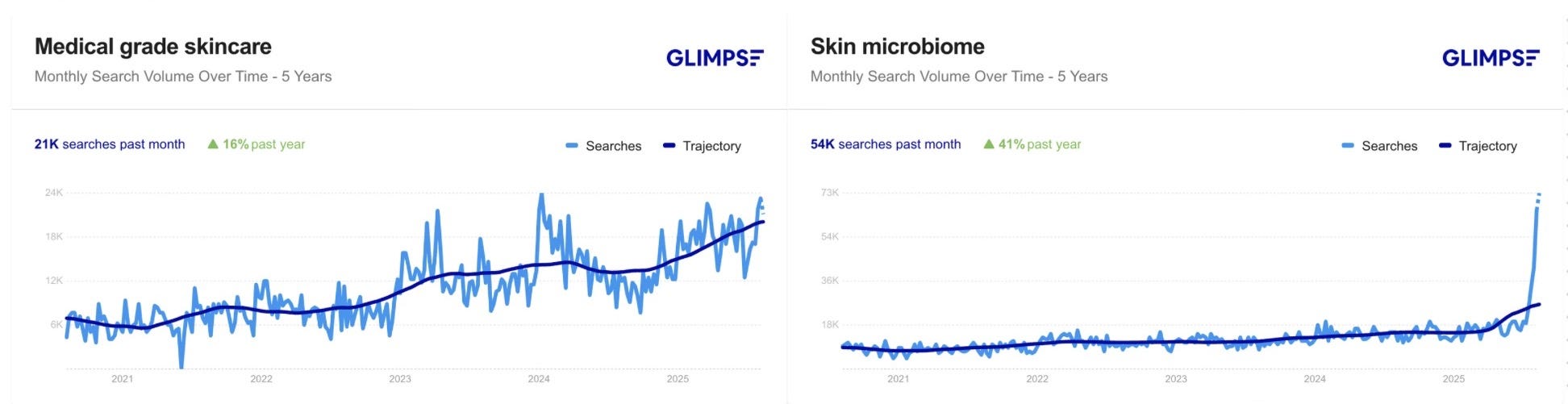
I mean, come on, it doesn’t get more science-y than that! A google trends search revealed that in the last month alone, “skin microbiome” racked up about 54,000 Google searches, a 41% jump from last year. Compare that to “medical grade skincare,” which pulled in 21,000 monthly searches with a 16% increase from the previous year.
Given the accelerating research on the skin microbiome and the growing number of brands entering this space, I believe interest and demand for microbiome-focused products will only continue to rise.
Beauty & The Skin Microbiome
Earlier this year, I wanted to get ahead of the curve, so I decided to do a literature review of skin microbiome research. Here is what I’ve learned so far:
According to Skowron et al.,2021, the human skin hosts a wide variety of microorganisms. Around 90% of the the bacteria found on our skin can be classified into four types: Actinobacteria (52%), Firmicutes (24%), Proteobacteria (16%), and Bacteroidetes (6%) . These bacterias are essential and their diverse presence contribute to the skin functioning properly, staying hydrated, and happy. But when the microbiome is disrupted, whether by an over production or under production of certain bacteria, it can lead to dysbiosis, or an imbalance that compromises skin health.
Dysbiosis of the skin can contribute to conditions such as acne, atopic dermatitis, and dandruff. This is why if someone is experiencing chronic acne, they may be prescribed clindamycin, a topical antibiotic, to help slow or stop bacterial growth on the skin.
Now I bet you’re wondering, what can cause the skin microbiome to go into dysbiosis?
Well, there are various intrinsic and extrinsic factors that can throw the skin microbiome off-balance:
Intrinsic (Internal): Age, Genetics, Gender, Immunity, Hormones, Sleep, Stress, Metabolism
Extrinsic (External): Hygiene, Beauty Routines, Exposure with chemicals, Availability of nutrients for microorganisms, Sunlight (UV radiation), Climate, Physical activity, Air and Water Pollution
For the rest of this article, we will focus on how beauty routines, specifically skin care products and routine, affect microbiome diversity.
According to this comprehensive review conducted by Mim et.al.,2024, skincare products can have either a positive or negative impact on the skin microbiome. The use of everyday products such as lotions, deodorants, body, hand, & face washes can have particularly significant effects. These products work independently and together to influence the microbiome.
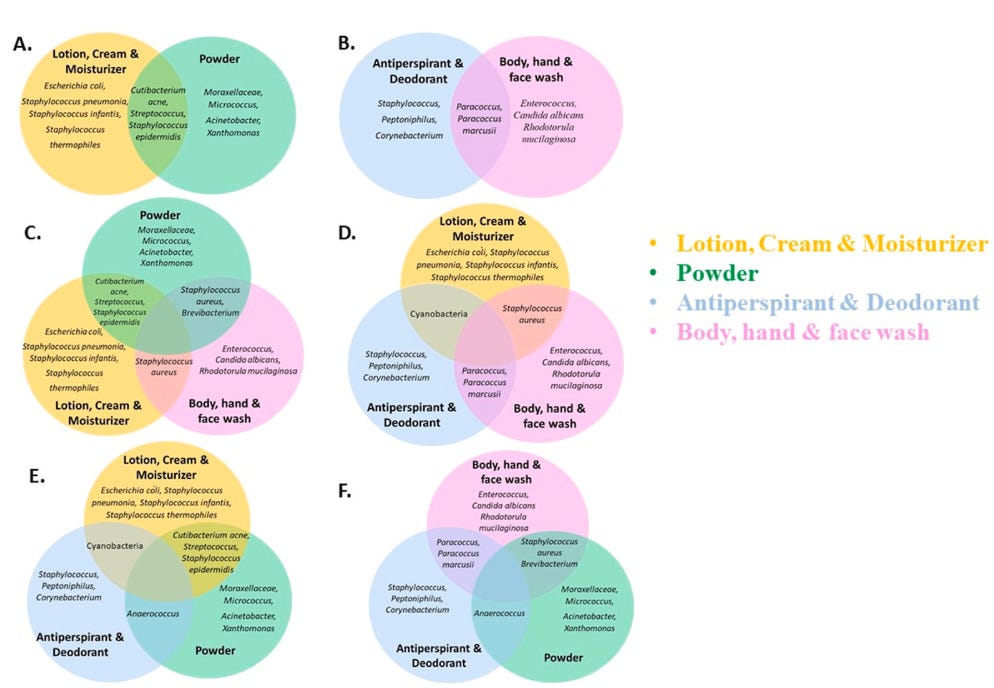
And don’t be alarmed! This isn’t necessarily a bad thing.
A 2019 study conducted by Bouslimani et al., evaluated the impact of 4 beauty products (a facial lotion, a moisturizer, a foot powder, and a deodorant) over 9 weeks across 11 volunteers. The researchers utilized mass spectrometry to detect host molecules and bacteria, and the results revealed that:
Compounds from beauty products can remain on the skin for weeks after use, indicating that products are never truly “one and done.” This aligns with the observation that it can take weeks to see visible effects from certain products.
The impact of each product was highly individual-specific; no two participants’ skin responded in exactly the same way.
Products use increased bacterial diversity on the skin.
In the Bouslimani study, researchers found that not using beauty products led to lower molecular and bacterial diversity. And remember, bacterial diversity is one of the main determinants for a balanced and healthy skin microbiome. But there is duality in everything, and while the use of products can positively impact the microbiome, they can negatively affect it as well by reducing bacterial diversity and throwing off balance.
However, the effects of skin care products on the skin microbiome aren’t necessarily random. It all comes down to how the products affect the skins hydration levels, pH, sebum content, and texture.
In a study conducted by Hwang et al.,2021, researchers examined how much skin hydration, texture, sebum content, and pH changed following daily use of a product. Results showed that skin biodiversity increased with product use meaning that the skin was essentially healthier. In addition to the increased biodiversity of the skin, the skin’s hydration, texture, sebum content, and pH levels all improved following product use.
Because multiple skin factors were tested with the product, it’s difficult to determine whether any one factor contributed more than the others to the increase in bacterial diversity.
For example, a different study conducted by Lee et al.,2018, found that improving skin hydration alone did not lead to greater bacterial diversity.
Overall, more research needs to be done on this topic for us to have a clearer understanding on how bacterial diversity changes with the implementation of products, but I do think the future of this research is promising.
My predictions for how the growing popularity of skin microbiome research will influence the beauty industry:
We can expect to see more products that incorporate prebiotics, probiotics, and postbiotics. A study conducted by Hong et al.,2020, found that participants who used a prebiotic serum containing galacto-oligosaccharides for eight weeks experienced reduced trans-epidermal water loss (meaning their skin was less prone to dehydration) and showed greater species diversity compared to participants who did not use the serum.
We can expect to see more products that target the skin microbiome with claims of improving mood and overall well-being. I recently came across a study that explored this connection across 53 participants. Researchers collected skin microbiome swabs from different areas of the participants body (forearm, face, scalp, and axilla) while participants also completed psychological assessments of general well-being (including the Affect Grid, sleep quality measures, Stress NRS-11, and PSS-10). The goal was to determine whether there was a correlation between the skin microbiome and psychological health. Results suggested that the presence of certain bacteria was linked to specific psychological outcomes. For example, higher levels of Cutibacterium were associated with lower stress levels.
We can expect skincare brands to begin measuring product effectiveness by evaluating how product use impacts the skin’s biodiversity. Rather than just reporting on the effect the product had on the skin’s elasticity, they will also report on the how the skin’s microbiome changed post product use as a way to prove to customers that the product actually works.
We can expect to see skincare brands leveraging skin microbiome research to deliver more personalized customer experiences. An example of this would be brands creating person specific formulations based on the individual’s skin microbiome. Because the microbiome is influenced by many factors, it is highly diverse and varies greatly from person to person, almost like a unique fingerprint. This means that when it comes to addressing skin concerns, a routine or product that works well for one individual may not work the same way for another, simply because their microbiome makeup is different.